Scope
The latest global scan found two organisms with June 9, 2026 open releases: HMPV with 1 record and Yellow Fever Virus with 21 records. I selected Yellow Fever Virus because a single HMPV sequence is not enough for primer or phylogenetic inference.
All records used here are dataUseTerms=OPEN, versionStatus=LATEST_VERSION, and non-revoked. The 21 new YFV records were imported from INSDC/NCBI by Pathoplexus and have NCBI accessions PX246671.1 through PX246691.1.
Interpretation is computational only. Any modified primer/probe should be wet-lab validated before diagnostic use.
New Data Profile
| Release date | June 9, 2026 in Pathoplexus; June 8, 2026 in NCBI release metadata |
|---|---|
| Countries | All 21 have missing geoLocCountry in Pathoplexus metadata |
| Completeness | Minimum 0.9949; mean 0.9992 |
| Lengths | 10,768 to 11,031 nt; mean 10,862 nt |
| QC note | PP_0072N3V.1 has one annotated frameshift in NS4b |
Clade Coverage
Tree Insight
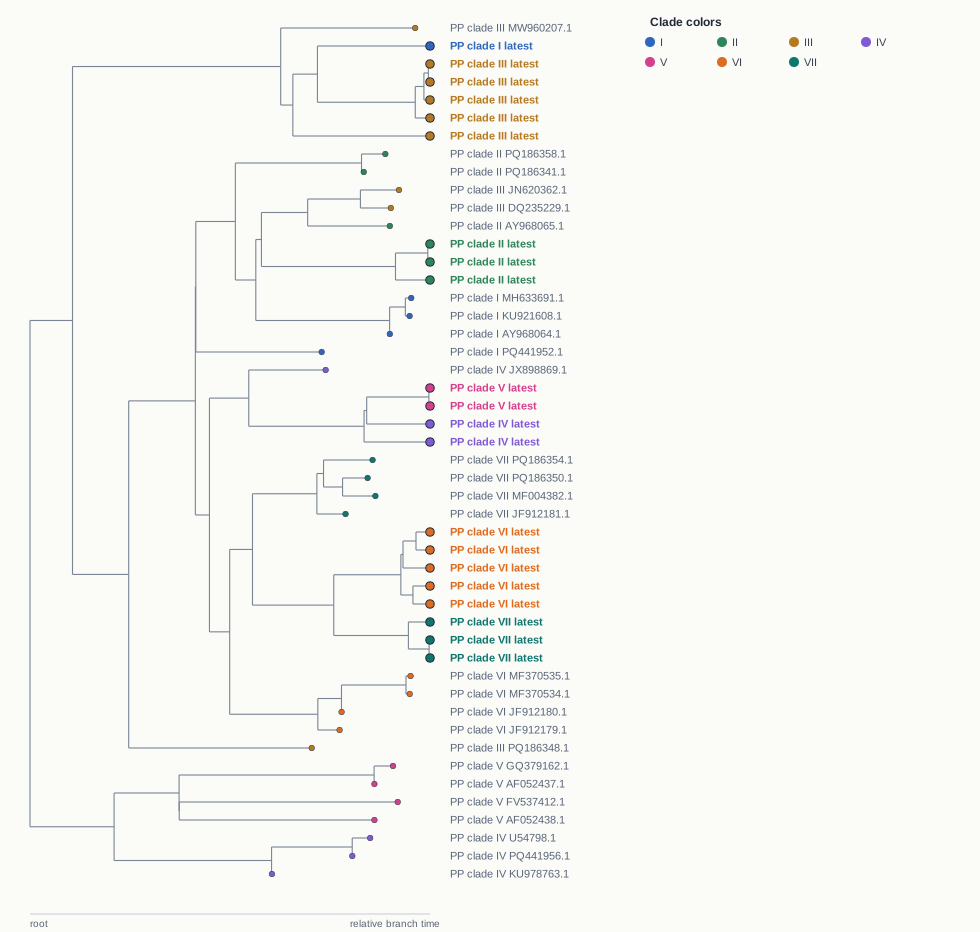
The 21 new records do not introduce a new Pathoplexus YFV clade label. In the Delphy MCC tree, the new records are distributed across existing clades I through VII.
Each new record's nearest prior context sequence is from the same clade. Nearest-context distances range from 1 to 351 comparable-site differences, with clade VI showing the largest distances to the sampled prior context.
| Clade | Latest records | Nearest prior-context distance range |
|---|---|---|
| I | 1 | 3 |
| II | 3 | 3-75 |
| III | 5 | 17-116 |
| IV | 2 | 1-6 |
| V | 2 | 66-69 |
| VI | 5 | 244-351 |
| VII | 3 | 1-6 |
Delphy MCC Tree
Delphy 1.3.4, 10,000 MCMC steps, 48 LAPIS-aligned sequences: 21 new records plus 27 prior same-clade, high-completeness open context records. Latest records are bold in the labels.
Primer Findings
The Primer MCP database search found no Yellow Fever hit in RAZOR, which is scoped to respiratory viruses. I therefore screened published YFV assays against the 21 new sequences.
| Assay | In-silico result on 21 latest records |
|---|---|
| Rojas/Waggoner DENV-YFV 5-prime UTR RT-qPCR | Forward primer exact in 21/21. The two published reverse variants together give exact reverse-primer coverage for 21/21. Probe exact in 18/21 and one mismatch in 3/21. |
| Escadafal 2014 YFV RPA | Primer exact coverage was incomplete in this tranche: RF exact in 15/21 and RR exact in 10/21. |
| Fischer 2017 lineage-specific assays | Designed for vaccine/wild-type lineage discrimination; exact primer coverage was incomplete across this mixed-clade tranche. |
Recommended Update
The existing Rojas/Waggoner primer strategy should still amplify these sequences if both reverse variants are used. To remove the split reverse-primer dependency and cover the three probe mismatches, I designed a degenerate computational update:
| Oligo | Sequence 5-prime to 3-prime |
|---|---|
| Forward | AGGTGCATTGGTCTGCAAAT |
| Reverse degenerate | TCTCTGCTAATCGCTCAAMG |
| Probe degenerate | GTTGCTARGCAATARACACAYTTGGA |
The recommended degenerate set has exact in-silico binding across 21/21 new records in this analysis.
Reproducibility
Data were pulled through the Pathoplexus MCP/LAPIS endpoint, Primer MCP database and recipe tools, NCBI EFetch, and Delphy 1.3.4. The Delphy MCP server supplied the local execution recipe; the binary was installed from the upstream Delphy GitHub release and run locally.
delphy_mcc
Delphy log10,000-step run log
NCBI FASTAUnique nearest prior INSDC sequences fetched from NCBI
Primary sources: Pathoplexus API documentation, Rojas et al. DENV-YFV RT-PCR assay, Escadafal et al. YFV RPA assay, Fischer et al. lineage-specific YFV RT-PCR, Delphy, and NCBI E-utilities.